
Cyber Talk-4 Beyond Endpoints: How CrowdStrike Reinvented Cyber Defense
A story of CrowdStrike

Valued at approximately $108.6 billion in market capitalization, Texas-based CrowdStrike is a global cybersecurity leader. Despite a major incident in September 2024, when a flawed update to its Falcon Sensor security software impacted around 8.5 million Microsoft Windows systems worldwide and drove the stock down to $242.25, the company has demonstrated remarkable resilience, recovering nearly 81.4% from that low and reaffirming its strong position in the cybersecurity market.
For those who are not familiar with CrowdStrike, a pioneer in cloud-native endpoint protection and threat intelligence, the company has long been a category leader with its powerful Falcon platform and widespread enterprise adoption. As organizations face increasingly sophisticated cyber threats, the rise of hyper-work, and growing regulatory pressures, CrowdStrike is positioning itself as a critical control plane for proactive threat detection, response, and security operations across the modern enterprise.
Endpoint Protection and Threat Intelligence
Imagine your organization as a bustling modern city. Every computer, laptop, server, and mobile device is like a gate into that city. If these gates are left unguarded, thieves, vandals, and spies can easily sneak in. Endpoint Protection is like placing highly trained guards and smart locks at every gate, they watch for suspicious activity, stop intruders in their tracks, and make sure the city keeps running safely. These guards notice unusual attempts to open doors, strange tools being used, or abnormal patterns—basically anything that looks like a potential breach.
But having guards isn’t enough if the attackers constantly invent new tricks. That’s where Threat Intelligence comes in, it’s the city’s intelligence agency and reconnaissance network. It gathers information from across the globe about the latest tactics, tools, and targets that attackers are using. This intelligence is fed to the guards so they know what threats to expect, who’s likely to attack, and which tools are most dangerous, allowing them to stop threats before they even reach the gates.
In short: Endpoint Protection is the frontline warrior defending every gate, while Threat Intelligence is the scout and strategist feeding the warrior real-time information about the enemy. Together, they keep your city secure and your digital endpoints standing strong in an increasingly dangerous world.
Why do we talk about CrowdStrike
The reason I’d like to write about CrowdStrike is because there are only ten companies in the history of cybersecurity history that have over 1B revenue so it is worth knowing why . Now, let us drive into the company to see more details.
The founder’s journey
George Kurtz’s background gives me more encouragement to continue my journey in the cybersecurity area. Believe it or not, he actually started his career in PwC, one of the big four as a CPA accountant after he got this BS of accounting. In 1993, he got into cybersecurity penetration tester because the firm established the security division to meet the market needs. He later joined Ernst & Young, where he continued penetration testing and helped develop internet security protocols and practices that remain part of the cybersecurity field. These experiences gave him deep insight into how attackers operate, the weaknesses of traditional security tools, and the growing need for proactive, intelligence-driven security.
In 2001, he co-founded Foundstone, a cybersecurity consulting and penetration testing firm that provided cutting-edge security services to Fortune 500 clients. Foundstone quickly became known for its expertise in vulnerability assessment, incident response, and risk management, and in 2004, Kurtz sold the company to McAfee.
At McAfee, Kurtz took on leadership roles in threat research and enterprise security, eventually becoming CTO and President of the Enterprise and Government Business. During this time, he witnessed the limitations of traditional endpoint security solutions: they were reactive, slow, and often insufficient against advanced, fast-moving threats. This insight planted the seed for his next bold move. After resigned from McAfee in 2011, Kurtz joined private equity firm Warburg Pincus as an "entrepreneur-in-residence" where he began developing the concept for a new cybersecurity venture
Founding CrowedStrike
In 2012, as the cybersecurity industry remained largely confined to traditional defensive approaches, George Kurtz, together with Dmitri Alperovitch (co-founder and former VP of Threat Research at McAfee) and Gregg Marston, launched CrowdStrike with a bold, transformative vision: cloud-native, AI-powered cybersecurity capable of detecting, preventing, and responding to breaches in real time.
Drawing on their extensive experience in the field, they imagined a new paradigm, proactive defense, recognizing that conventional signature-based antivirus solutions could no longer keep pace with increasingly sophisticated attacks. This philosophy of “prevention over cure” became the foundation of CrowdStrike’s approach.
At the heart of the company’s innovation is the Falcon platform, which unites endpoint protection, threat intelligence, and proactive threat hunting, enabling organizations to detect and neutralize attacks faster and more effectively than ever before.
CrowdStrike’s management also stated that they had invented a new cybersecurity category called the “Security Cloud.” The Security Cloud was introduced to better counter modern hacker strategies while providing powerful backend support for the Falcon platform. Leveraging the scale of cloud computing and AI, the Security Cloud processes trillions of cybersecurity events every week, correlating them with attacks, threat intelligence, and enterprise data to generate actionable insights. These insights help identify shifts in adversary tactics and automatically detect and prevent threats across the entire customer base.
Product and Competition
By 2012, Falcon was rolling out pilot deployments to early adopters in tech, finance, and government, companies frustrated with traditional antivirus tools that couldn’t keep up with sophisticated attacks. The cloud-native design and proactive threat hunting made Falcon stand out, catching malware in real time and identifying suspicious background processes that other solutions often missed.
The core product Falcon Sensor actively monitors for these suspicious background processes and halts them before they can execute, preventing infections in real time. Unlike legacy endpoint protection, CrowdStrike’s cloud-native architecture leverages network effects, the more endpoints connected, the smarter its AI becomes at detecting malicious activity, including novel and evolving threats. By combining AI with IoA detection and scaling it across the cloud, Falcon continuously trains its threat models on data collected from countless endpoints worldwide.
Positive results quickly turned pilots into full-scale enterprise contracts, bringing in tech giants and large financial institutions willing to bet on the founders’ expertise. In the following years, CrowdStrike expanded Falcon into a full-fledged Endpoint Protection Platform (EPP) with AI-driven Indicators of Attack (IoA) detection. By 2015, the launch of Falcon X integrated threat intelligence directly into the platform, providing real-time insights and attack attribution that helped organizations stay ahead of adversaries. Over the next few years, the Falcon platform grew its capabilities further with Falcon Discover, offering asset visibility and IT hygiene, and Falcon OverWatch, a human-led, AI-augmented threat hunting service.
CrowdStrike didn’t just innovate in software, it also strategically expanded through acquisitions. In 2020, the acquisition of Preempt Security brought identity protection and zero-trust capabilities to the platform. CrowdStrike CEO George Kurtz explained, “After completing the second round of the ‘100 Days, 100 Customers’ tour (where I met with 100 customers and prospects in 100 days), I heard clearly that enterprises are looking for a modern, identity- and workload-centric zero-trust security strategy to serve as the foundation for their security transformation.”
After integrating with Preempt’s technology, CrowdStrike launched a new identity protection platform, Falcon Identity Protection, designed to safeguard employee identities and enable seamless zero-trust security for enterprises. Given that 80% of successful breaches involve compromised credentials, Falcon Identity Protection unifies identity threat detection with conditional access for both on-premises and cloud identities, helping organizations prevent attacks before they happen.
In 2021, the purchase of Humio integrated observability and log management, extending Falcon’s reach into cloud workloads and security analytics. In October 2021, CrowdStrike also announced the launch of its pioneering XDR module, providing real-time detection and automated response across the entire security stack. At the same time, it introduced Fusion, an automated workflow solution designed to enable a full SOAR (Security Orchestration, Automation, and Response) framework.
A year later, SecureCircle strengthened data protection, while Falcon Fusion added orchestration and automation to streamline security operations. After incorporating SecureCircle’s technology, CrowdStrike modernized its approach to data protection, extending its frictionless zero-trust model to frictionless data security. This enables customers to implement zero trust simultaneously across multiple layers—device, identity, and data—for comprehensive, end-to-end protection.
The crown jewel came in 2023, with the integration of Mandiant, bringing world-class threat intelligence, incident response, and consulting services under the CrowdStrike umbrella. This move transformed Falcon into a complete XDR ecosystem, connecting endpoint, network, and cloud telemetry with AI-driven detection and proactive response.
By integrating endpoint protection, threat intelligence, zero trust, XDR and cloud security into a single, AI-driven platform, CrowdStrike delivers comprehensive protection for modern enterprises. Its strengths lie in proactive detection, broad enterprise adoption, and continuous threat model improvement.
In 2024 Q4, CrowdStrike CEO confirmed their pjatformization strategy once more time: "As you can imagine, last week I heard a lot of talk about 'platformization.' To me, it’s a bit of a buzzword. But what I believe our competitors are really talking about is bundling, discounts, and giving away products for free, something that’s not new in software or security software; it’s been happening for the past 30 years. So, when we look back at past collaborations with other vendors, we know that ‘free’ is never really free. Users end up with more hosts, more point products masquerading as a platform, leaving their environments exhausted. One thing we’ve always focused on is that a single-agent architecture, a single platform, and a single console enable us to prevent violations. More importantly, it reduces operational costs while addressing many use cases, or solving multiple use cases at once." This strategy significantly reduces the operation costs and provide more value to the customer.
So far, the market that CrowdStrike in is still a good business. According to Gartner and IDC reports, the global EPP market was valued around $11–13B in 2024.It’s projected to grow at a CAGR of 10–12%, potentially reaching $20B+ by 2028–2030, driven by cloud adoption, hybrid work, and AI-enabled threats.
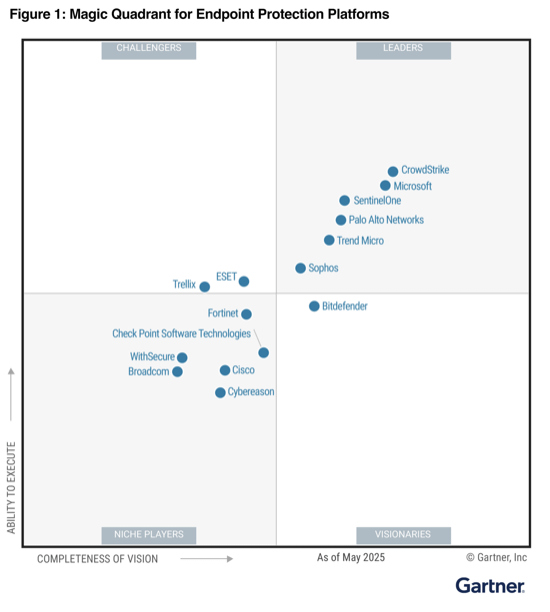
Picture today’s enterprise battlefield: hybrid workforces, cloud workloads, and AI-driven applications, constantly under attack from increasingly sophisticated adversaries. In this landscape, CrowdStrike has emerged as a category-defining leader, consistently recognized in Gartner’s 2025 Endpoint Protection Platforms (EPP) quadrant for its combination of vision and execution.
It also has carved out a leadership position in cybersecurity by focusing on Indicators of Attack (IoA) rather than relying solely on traditional signature-based detection. While threats such as malware, ransomware, phishing, and spear phishing come in countless variants, they all share one fundamental requirement: to execute, they must run processes that leave identifiable patterns. These patterns may manifest as changes to Windows registry entries, creation of new user accounts, or initiation of encryption routines on a host.
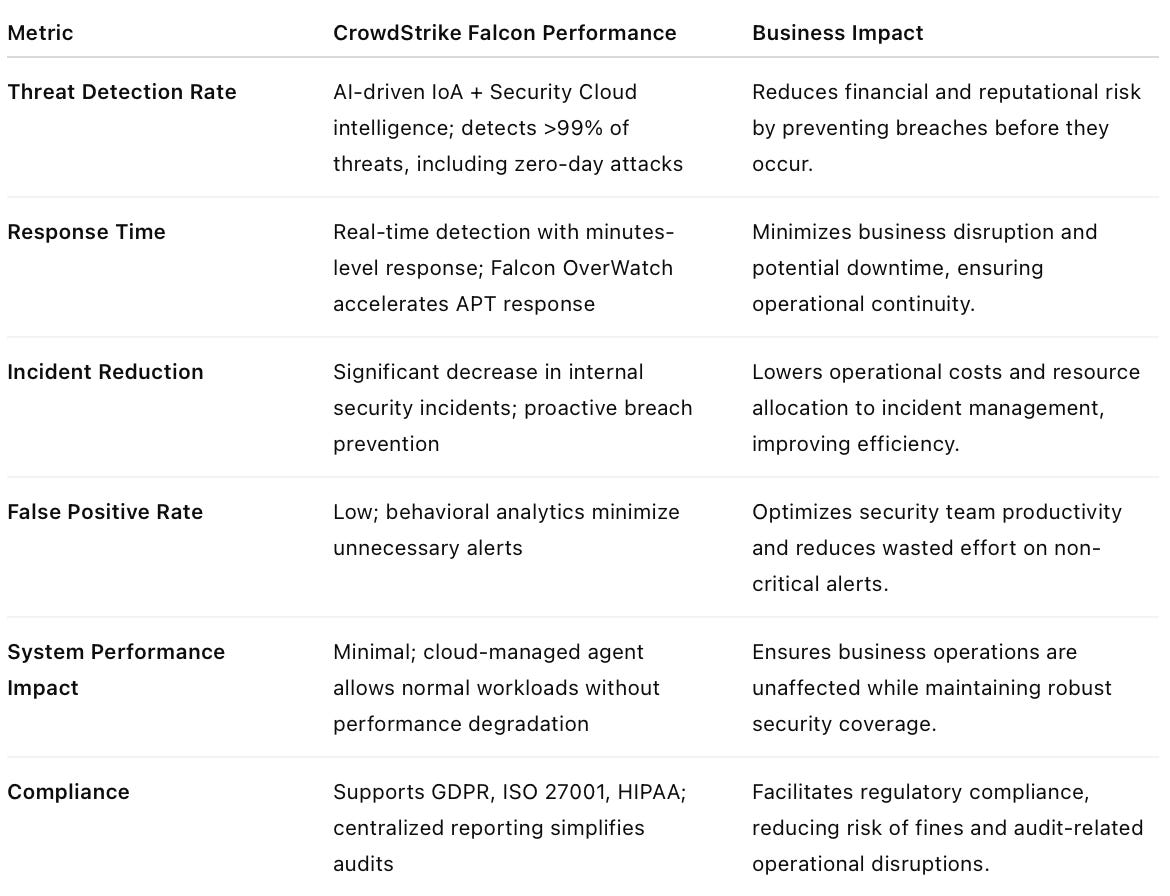
If you use end point security key metrics to evaluate the CrowdStrike product, you will understand why it is on the top of the Gartner chart:
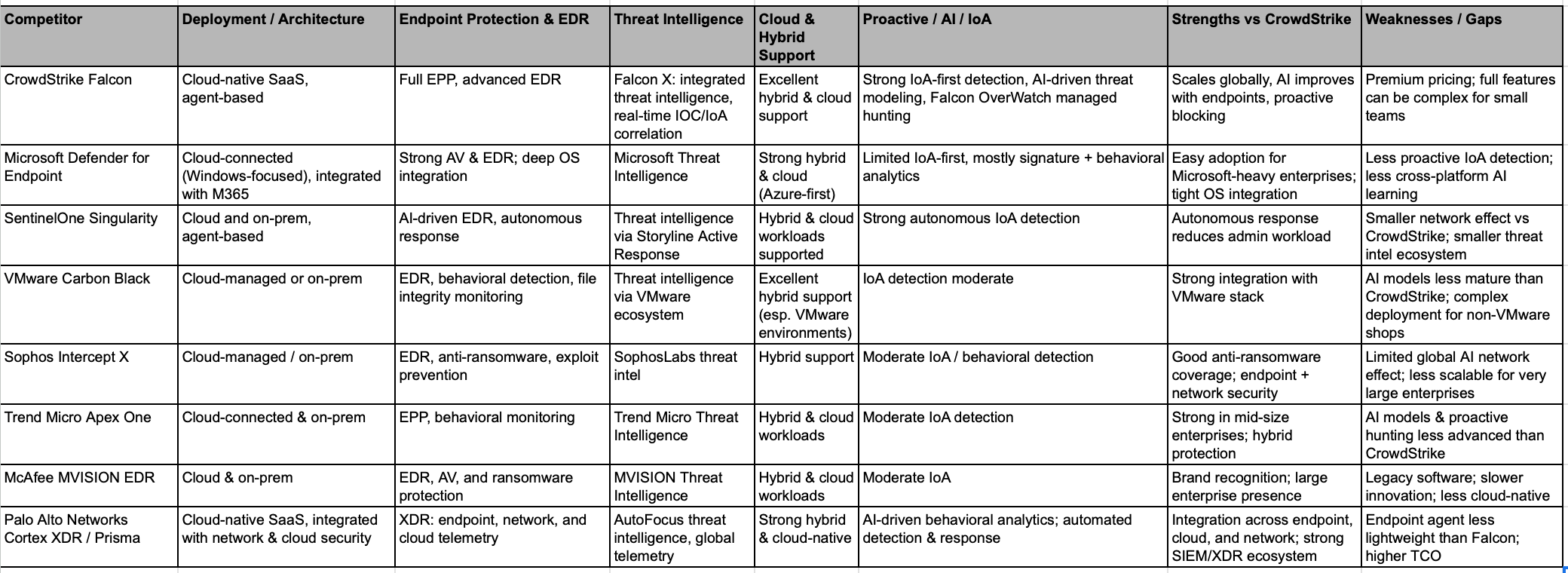
If you compare CrowdStrike to its competitors, you can find out some very interesting:
IoA & Proactive Defense Leaders: CrowdStrike and SentinelOne are the most aggressive in AI-powered, proactive detection. CrowdStrike adds managed hunting (OverWatch) and global AI network effects, giving it an edge in preventing zero-day threats. Palo Alto’s Cortex XDR also offers strong behavioral analytics but is broader across network and cloud security.
Cloud-Native Advantage: CrowdStrike, SentinelOne, and Palo Alto leverage SaaS models for continuous AI updates, threat intel sharing, and scalable deployment. Legacy vendors like McAfee and Trend Micro rely more on hybrid or on-prem options.
Enterprise Adoption & Ecosystem: CrowdStrike’s Falcon platform benefits from rapid adoption, creating network effects for AI learning. Microsoft Defender benefits from OS-level integration and enterprise ubiquity, while Palo Alto benefits from multi-layered security integration.
In short, CrowdStrike has rewritten the rules of endpoint security. It is no longer about reacting after breaches occur, it’s about predicting, preventing, and responding faster than attackers can adapt, making CrowdStrike the go-to solution for enterprises navigating the complex and evolving threats of today’s digital world.
Pricing Model
When CrowdStrike first started thinking about how to price its Falcon platform, the team knew one thing: cybersecurity isn’t one-size-fits-all. Organizations vary, from small startups with minimal IT staff to global enterprises managing thousands of endpoints across multiple continents. So CrowdStrike built a model that could grow with a customer’s needs, while keeping the value clear at every step.
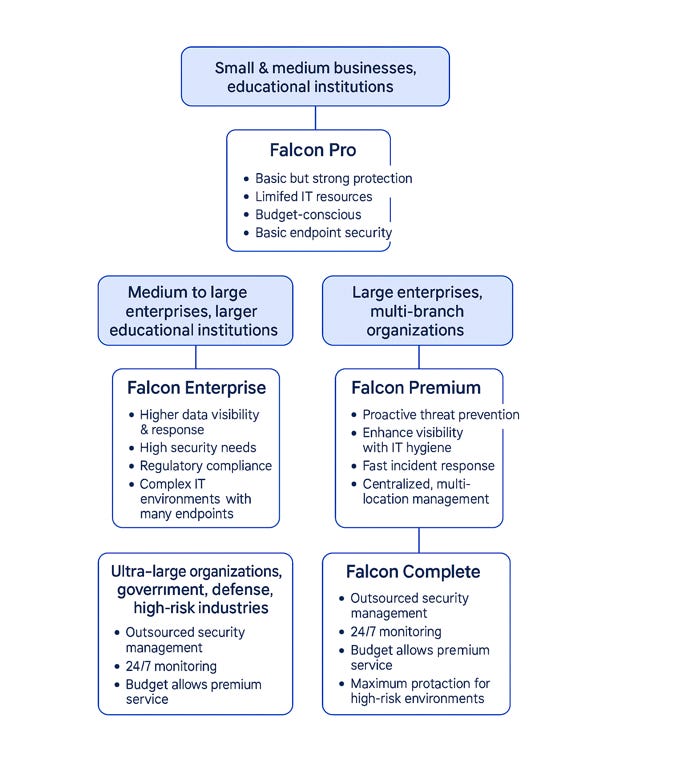
At the entry level, Falcon Pro gives small and medium-sized businesses the essentials: strong endpoint protection, threat intelligence, and easy deployment for teams with limited IT resources. It’s like having a security guard who never sleeps, at a cost that won’t break the budget.
As organizations grow, Falcon Enterprise steps in, offering advanced threat detection, incident response, and visibility across complex IT environments. Financial institutions, healthcare providers, and other high-security industries rely on this tier to meet compliance requirements and protect sensitive data, because in these industries, even a single breach can cost millions.
For large enterprises that need proactive defense, Falcon Premium goes beyond reactive security. It provides automated IT hygiene, vulnerability scanning, and rapid response tools, helping IT teams find and stop threats before they can cause damage. It’s the difference between reacting to fires and preventing them.
At the top of the line is Falcon Complete, a fully managed service where CrowdStrike’s experts handle detection, threat hunting, and response 24/7. This is for high-risk organizations, think government, defense, and top-tier finance, that want absolute certainty their assets are safe, while freeing internal teams to focus on strategic priorities.
If you map the customer groups to its core product packages, you will see the clear picture:
Target Customers and GTM Strategy
CrowdStrike currently serves over 24,000 customers, including a large portion of the Global 500, such as Tesla, Microsoft, and Amazon. Its reach spans diverse industries, from airlines and broadcasters to banks and healthcare organizations, demonstrating the platform’s broad adoption and trust across critical sectors.
From small and medium-sized businesses to massive multinational enterprises, Falcon protects organizations that value cybersecurity as a strategic asset. Its story is one of trust, innovation, and relentless defense, a narrative where every endpoint is a frontline, and CrowdStrike ensures its clients are always ready for what’s next.
From go-to market perspective, CrowdStrike’s Falcon platform has earned multiple awards from leading research and consulting firms and consistently achieved top scores in independent cybersecurity tests, cementing its reputation as a best-in-class solution. The company also became the first cloud-native independent software vendor (ISV) to surpass $1 billion in software sales through AWS Marketplace, highlighting its innovative approach to distribution. By 2025, CrowdStrike’s annual recurring revenue (ARR) reached $3.15 billion, up 35% year-over-year, demonstrating the strength of its GTM strategy. This success is driven by several key factors:
First, CrowdStrike’s data collection advantage allows it to continually deliver high-quality security services: every new customer contributes high-fidelity data to its Security Cloud, improving detection, prevention, and response capabilities for the entire platform.
Second, the platform benefits from strong network effects, as more endpoints connect, the system becomes smarter, accelerating AI training and threat intelligence.
Third, customer stickiness reinforces growth: the deeper an organization’s investment in Falcon, the higher the cost of switching, encouraging long-term engagement.
Finally, CrowdStrike continuously leverages this data to optimize and evolve its solutions, ensuring that Falcon adapts to the ever-changing threat landscape. Together, these factors form a virtuous cycle that drives rapid adoption, sustainable growth, and market leadership.
Quick Financial Check
Great product and go-to-market lead to the good funding history and financial as well:
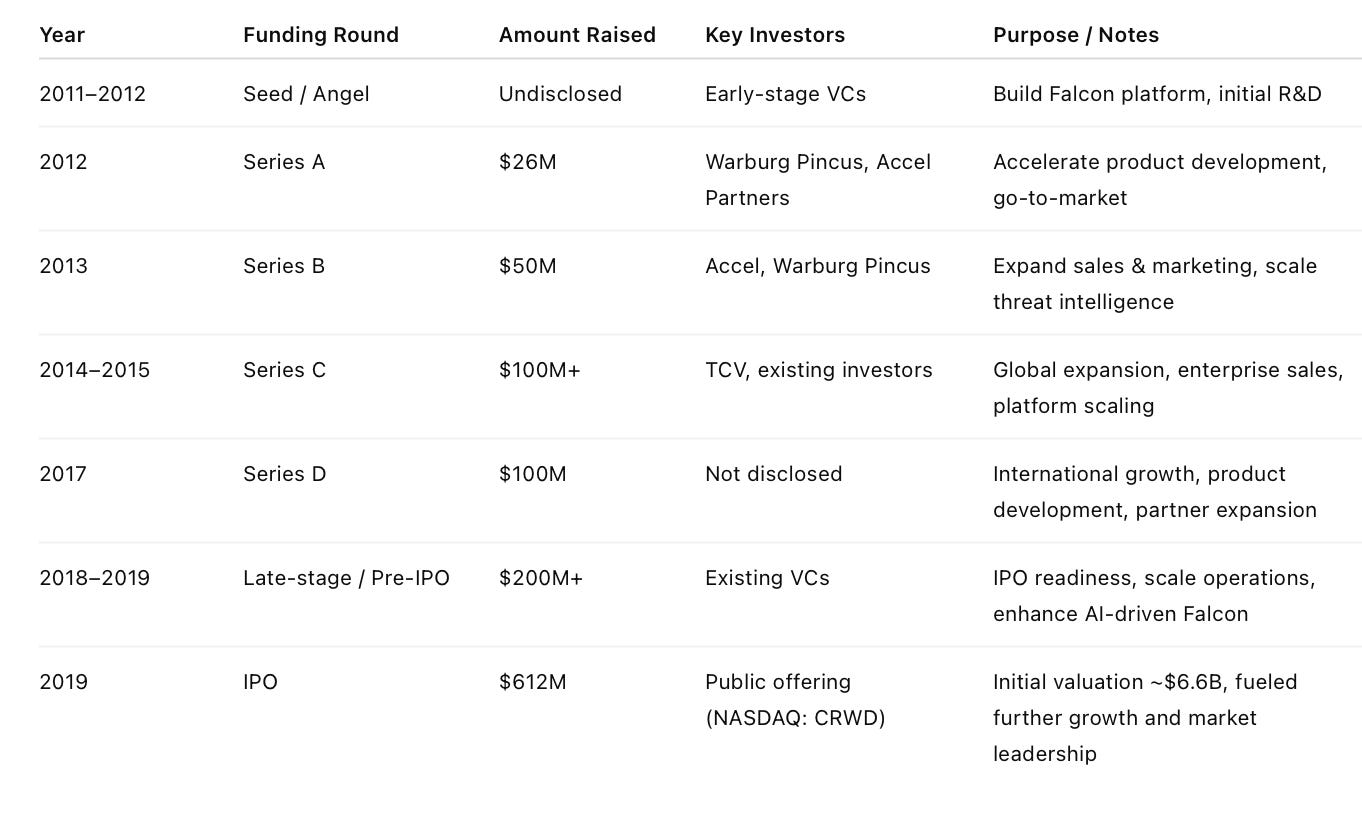
Financially, the company has seen robust expansion, with annual recurring revenue (ARR) reaching $3.15 billion, a 35% increase year-over-year, reflecting strong subscription growth and the stickiness of the Falcon platform. Total revenue for FY2025 reached $2.88 billion, growing roughly 37% compared to the prior year. CrowdStrike maintains healthy gross margins around 76–77%, highlighting the efficiency of its cloud-native, SaaS-first model. Its $1.5 billion in cash reserves positions the company to continue investing in platform expansion and M&A opportunities.
The real power behind CrowdStrike’s financial performance comes from its Security Cloud and network effects. Every new customer adds high-fidelity data to the platform, improving threat detection and fueling Falcon’s AI-driven capabilities. This virtuous cycle not only strengthens the product but also drives high customer retention, expansion, and cross-sell opportunities, ensuring that CrowdStrike’s growth story is far from finished.
What's Next for CrowdStrike?
CrowdStrike has come a long way from its early days as a cloud-native endpoint protection startup. But the journey is far from over. Today, the company is pivoting from being just an endpoint security provider to becoming a holistic, intelligence-driven cybersecurity platform that protects identities, workloads, endpoints, and data—all under the umbrella of its Security Cloud.
The next chapter for CrowdStrike centers around three key pillars:
Expanding Identity and Data Protection
With the acquisition of Preempt and SecureCircle, CrowdStrike is now deepening its zero-trust offerings. Falcon Identity Protection and data-centric zero-trust extend protection beyond endpoints, ensuring that compromised credentials or sensitive data don’t become vectors for attacks. The goal is clear: provide frictionless, multi-layered security across devices, identities, and data.Strengthening AI and XDR Capabilities
CrowdStrike’s proactive defense philosophy, combining Indicators of Attack (IoA), AI-powered models, and Falcon OverWatch’s managed threat hunting, will evolve further. New modules in XDR and Fusion automation promise real-time, cross-stack threat detection and response, helping organizations anticipate and neutralize attacks before damage occurs.Global Scaling and Platformization
CrowdStrike aims to turn its network effect into a competitive moat. Every new endpoint, identity, or workload added to the Falcon platform enriches the Security Cloud, providing smarter threat intelligence for all customers. The company is also working to simplify deployment for global enterprises, integrating multiple security layers into a single agent, console, and operational workflow, reducing costs while expanding coverage.
In essence, CrowdStrike’s future isn’t just about stopping malware, it’s about shaping a unified, AI-driven, cloud-scale security ecosystem where customers can trust their endpoints, identities, and data are protected, while the platform continually learns and adapts to an ever-changing threat landscape.
Conclusion:
Today, CrowdStrike has elevated its platform beyond traditional endpoint protection, positioning itself as a comprehensive SaaS-based solution that integrates endpoint security, threat intelligence, and cloud protection.
For organizations navigating hybrid workforces, cloud workloads, and increasingly sophisticated adversaries, CrowdStrike offers more than protection, it provides visibility, intelligence, and assurance that every endpoint, identity, and byte of data is continuously monitored and defended. As the cybersecurity landscape evolves, CrowdStrike’s platform-centric strategy and innovation-driven culture suggest that the company is not only prepared to defend against today’s threats but also to anticipate and neutralize tomorrow’s challenges, solidifying its leadership and influence for years to come.